
初代吸血鬼
Twin AI satellites fast-track China's global space partnerships_我的网站

A | New Delhi, Oct 17 (UNI) The Gujarat government in its detailed affidavit filed before the Supreme Court in Bilkis Bano's 11 convicts remission case, said that third party strangers have no locus to challenge remission orders passed by competent authority strictly as per applicable law.
"It is pertinent to note that the petitioner, (Subhashini Ali) who is admittedly a political functionary, has not even pleaded that how she has the locus to seek for quashing the order of remission passed by the Respondent number 1 (Gujarat government) with respect to the 11 convicts sentenced by the Special Judge, Greater Mumbai," the Gujarat government in its detailed affidavit filed before the Supreme Court said.
Questioning the maintainability of the batch of pleas challenging the release of 11 convicts in Bilkis Bano case, Gujarat Govt has told the Top Court in its affidavit said that the petitioner (Subhashini Ali and others) has nowhere in the petition has pleaded as to how her fundamental rights have been abridged.
"The petitioner (Ali) also failed to establish as to how she is aggrieved by the action of the State Government. The mandatory pleadings of locus and infringement of fundamental rights is conspicuously missing from the petition," the affidavit copy of the Gujarat government, filed before the Supreme Court, said.
The Gujarat government has filed its affidavit after complying with the Supreme Court's order, which had heard the petitions by Subhashini Ali and others challenging the remission of the 11 convicts in the Bilkis Bano case.
The Supreme Court will tomorrow hear the petitions filed by CPI (M) Memnber of Parliament (MP) - Subhashini Ali, journalist Revati Laul and Prof Roop Rekha Verma challenging the Gujarat Government’s decision to grant remission to 11 convicts for killing 14 persons and sexually assaulting pregnant Bilkis Bano during the 2002 post-Godhra riots.
The Gujarat government had on August 10, 2022, in its order granted remission to 11 convicted rapists and child murderers from jail, which created a hue and cry in the society.
"It is the bonafide belief of the state government that the present petition is nothing but an abuse of PIL (Public Interest Litigation) jurisdiction of this court. Thereby this Court should dismiss all the related pleas challenging the remission granted to 11 convicts in Bilkis Bano case.
The State Government has considered the cases of all 11 Prisoners as per the policy of 1992 and remission was granted on August 10, 2022, it said.
The State Government considered all the opinions and decided to release 11 prisoners since they have completed 14 years and above in prisons and their behaviour was found to be good. After approval of the State Government, orders have been issued on August 10, to release the prisoners. Hence, in instance case the state has considered the proposals under policy of 1992 as directed by this Court and not granted under the circular governing grant of remission to prisoners as part of celebration of "Azad Amrit Mahotsav," the Gujarat government said, in its affidavit.
UNI XC SHK2300。
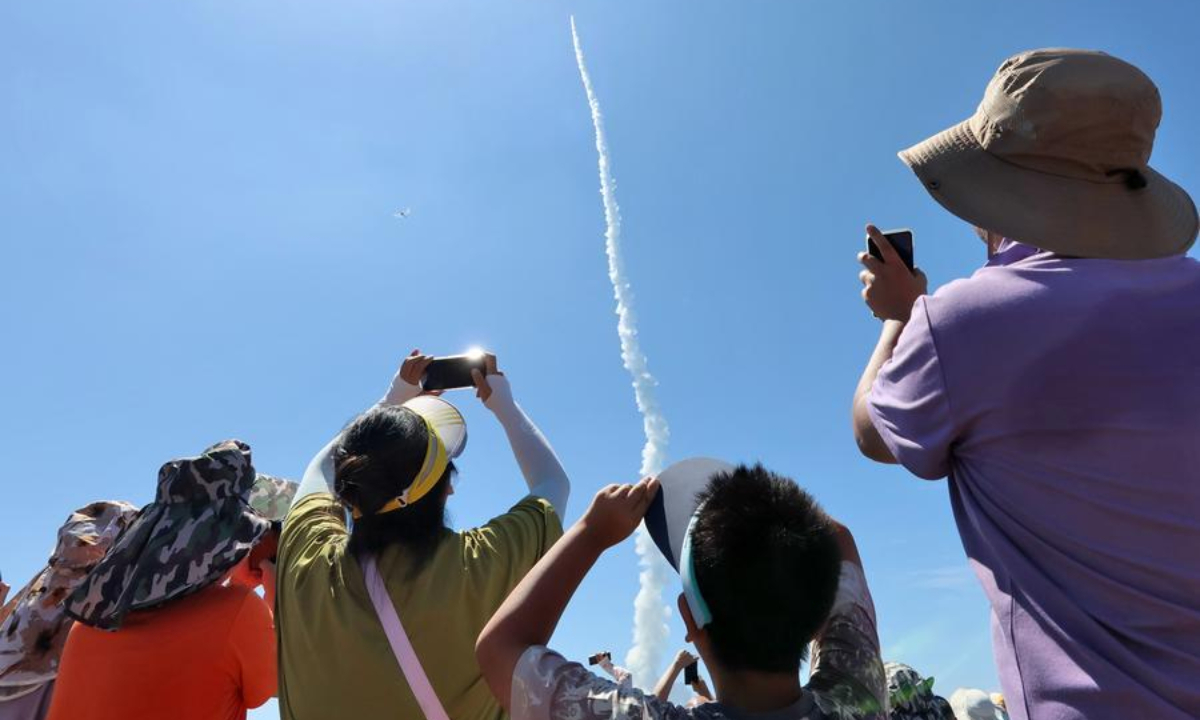
A burst of flame lit the morning sky over waters off Haiyang in east China's Shandong Province on Wednesday as a Smart Dragon-3 (SD-3) carrier rocket lifted off, drawing cheers from viewing sites along the coast.
Among the spectators were international students studying aerospace subjects in China. Aithana Perez, a Venezuelan aeronautical engineer studying space project management at Hangzhou Innovation Institute of Beihang University, said she and her classmates were excited because their studies involved spacecraft launch, design and operation.
For Marwane Oufrid, a 23-year-old Moroccan student in the same institute specializing in microsatellite technology, it was the first time he had watched a rocket launch in person.
The rocket blasted off at 10:38 a.m. (Beijing Time), delivering the Oriental Smart Eye hyperspectral satellites 01 and 02 into planned orbit.
In their respective cooperation projects with Indonesia and Uzbekistan, Satellite 01 is also known as Lampung-1 and Satellite 02 as Samarkand-2028.
Once in orbit, the satellites turned their attention back toward Earth. Lampung-1 is expected to monitor crop growth and disaster risks in Indonesia, while Samarkand-2028 is designed to support cotton cultivation and other land-monitoring applications in Uzbekistan.
Ordinary optical cameras mainly record the shape and color of objects. Hyperspectral imagers record a detailed spectrum for each image pixel, creating "spectral fingerprints" that can help determine the condition and composition of vegetation, water, soil and minerals.
These spectral "eyes" are paired with onboard AI computing modules capable of delivering up to 400 trillion operations per second. Instead of sending every raw image to the ground, the satellites can identify features, detect anomalies and extract useful information in orbit, potentially shortening delivery time from days to minutes.
Song Bingchen, co-founder of the Star.ai Spatio-temporal Intelligence Technology Co., Ltd., whose subsidiary STAR.VISION developed the satellites, compared the system to moving an AI inference platform from the ground into space.
"It changes the traditional model from transmitting images to transmitting results," Song said.
"Our satellite constellations are open to the world," Song noted, adding that the company welcomes international partners to jointly invest in, build and use the satellite networks.
In Indonesia, Lampung-1's planned applications are centered in Lampung Province on the island of Sumatra. Agriculture, forestry and fisheries accounted for 28.38 percent of the provincial economy in the third quarter of 2025. The satellite will also support marine resource management, environmental monitoring and disaster response.
Rahmat Mirzani Djausal, governor of Indonesia's Lampung Province, described the successful launch as a "historic moment" for the province.
"Cooperation with China on this satellite project is of historic and strategic significance," he said. "It marks the beginning of Lampung's transformation into a technologically advanced province."
The governor commended China's openness in sharing space technology and its commitment to long-term cooperation.
"China understands that any problems we face on one side of the world will ultimately impact the other side. Therefore, it is essential to empower regions that are left behind to make the world ultimately a better place," he said.
This cooperation also extends to people. Lampung is preparing to send over 100 young professionals to China for training in remote sensing and satellite communications, with the goal of building local capacity in satellite operation, data processing and spatial analysis.
In Uzbekistan, the applications center on cotton, grain and vegetation monitoring. Samarkand-2028 is designed to follow cotton cultivation from sowing to harvesting, while Uzbekcosmos has said hyperspectral data will also be used to produce national cotton and wheat maps.
Mukhiddin Ibragimov, deputy director of the Uzbekcosmos Agency, described the project as one of the largest international space projects in Uzbekistan's history and a milestone in its national space program.
He called the launch "a great occasion," saying it was the first time Uzbekistan had participated in an international space mission of such scale.
Ibragimov said Uzbekistan sent a technical team to China early in the project and formed a working group with Chinese specialists to develop an AI model for onboard data analysis. This model focuses on crop classification, including cotton verification, grain identification and vegetation monitoring.
The resulting data will support agriculture, water resource management, environmental protection and emergency monitoring, among other applications, he revealed.
Ibragimov said no single country can handle all space-related tasks alone.
"We believe that partnership brings value. We see that China is doing the same thing," he said, adding that Uzbekistan is exploring further satellite cooperation with China.
The projects offer a commercial example of the approach set out in China's 2021 space white paper, which called for international cooperation based on equality, mutual benefit, peaceful utilization and inclusive development.
Back in Haiyang, Oufrid said projects of this kind could give more countries an opportunity to participate in the space sector. He expressed the hope to see such cooperation happen more often and "maybe someday with Morocco as well."
。
Current article:http://gtc.deshabisaoguonouzuo.cfd/list_wkwnky/f4b.pptx
Published on:14:44:01
我的网站最近更新
- 湖人官方致敬科比:让篮球运动因你变得更好
- 【仓单】8月26日大商所塑料期货仓单较上一日持平
- The Guardian fires longtime cartoonist after allegations of antisemitic imagery
- 福州江阴港区迎2026年中欧北极快航首靠 福州海事局全力护航外贸新通道
- Heatwave fuels surge in self service pet baths, boarding hotels in Chengdu
- 贝尔的“空中出租车”出现在CES上。
- 第一次!湖南口岸首次进口非洲咖啡豆_长沙_查验
- 厦门:今明两天“隐形高温” 后天雨水驱暑
- 抚顺大官窑邀请展即将启幕 倒计时1天!“瓷”韵悠长
- 火箭媒体人:乌度卡是NBA前十的教练 火箭能在他带领下夺冠
- 植入多元业态,福州地铁站向公共服务空间转型
- Zhuque-3 Y2 landmark recovery test marks China’s dual-track reusable rocket development, aerospace experts say
- 一场脱口秀带火这只股!开盘一字涨停!公司紧急回应!_脱口秀演员回应带火股票“600759”_一场脱口秀带火一支股票?公司回应
- 马云:真正的教育就是想办法让每个孩子都成为自己最好的自己。
- 厚衣服+++ 今冬首场降雪要来了……
- 旷课辍学、学生欺凌、未成年人文身如何管?《福建省预防未成年人犯罪条例》将于9月起实施
- 鲁媒:山东引进王岚嵚经过了两个月谈判和等待 来来回回 诚意满满
- 约三成美国人支持美国对伊朗战事,特朗普支持率创历史新低
- Extreme weather dents Guangzhou's second-hand home transactions in July
- Neena Gupta, Sanjay Mishra Look Intense in The Latest Poster of Vadh 2
- China achieves mass production of advanced specialty steel across multiple sectors
- BBC:纽卡签尼科·冈萨雷斯已达协议,转会费最高可达5200万英镑
- China's 'Lychee Capital' Maoming posts record exports despite off-year
- 官方:狼队边卫霍福尔转会布拉格斯巴达,球员曾效力于利物浦
我的网站热门资讯
- 市总工会开展廉政警示教育
- 韩国瑜与卓荣泰隔空交锋,徐巧芯:雷霆之怒早该发
- 美国证券交易委员会数据库遭到入侵,犯罪分子非法获利410万美元。
- 泽连斯基独立日讲话:俄方曾视乌克兰为小兄弟,但现实证明我们是陌生人;美国已完全放弃普京想要结束战争的幻想,乌克兰将对俄进行大反击
- 就是这样!外国兄弟用蓝牙扬声器录制了黑视频。
- 33 killed in Nepal floods, landslides
- 队记:骑士在商讨惠特摩尔去留问题 他留队前景并不乐观
- Mohanlal In Iruvar: When An Icon Played Another
- 11K分辨率VR相机Insta360 Titan:8个镜头,99 888元
- 北京监狱开通支付宝扫码押金:每月一次,最高每次1000元。
- When Alia Bhatt & Sidharth Malhotra Helped Shakun Batra Manage Rishi Kapoor On Set
- Allu Arjun Met 5 Directors; Circumspect Over His Next Film
- 普里查德:和塔图姆等人在LA边玩边练 感觉很不错
- Amphibious assault ship passes combat test
- 张小龙回应微信7.0的“丑陋界面”:产品需要适应时代
- 全市各级工会开设职工子女假期托管班 “托”起孩子多彩假期
- Haynes:因场上冲突时没有去帮队友 波尔被布登DNP到赛季结束
- 兴城市:为青年大学生搭建服务家乡桥梁
- China expands community meal services for seniors nationwide
- 官方:中国女篮将开启高原训练,要求4周内完成1万次投篮
- 名记曝活塞与杜伦续约谈判已陷入高度紧张状态
- 德天空:马丁内利准备同意加盟利雅得新月,各方几乎已经达成协议
- Pak to demarche US envoy over Biden's statement on nukes: FM
- 孔塞桑回应帅位传闻:有时感到缺乏尊重,我的未来就是明天